
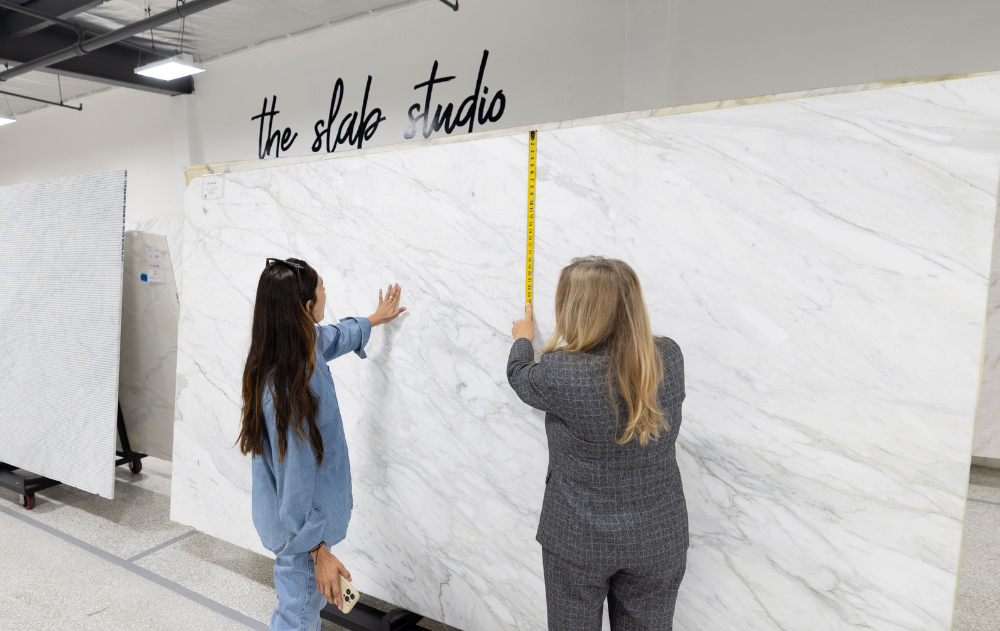
There is a version of natural stone slab sourcing that most trade professionals in Southern California have experienced at some point.
You call the slab yard. You are told the material you want is in stock. You drive to the yard, walk through rows of material in conditions that make accurate color evaluation nearly impossible, find something close to what you need, buy it, and discover on the fabrication table that what looked right under full outdoor sun looks different under the controlled light of your client’s kitchen.
Or you discover that the two slabs you purchased do not match — not because they were mislabeled, but because no one tracked whether they came from the same block.
Or you discover that the material you held for three weeks was sold to someone else while you were waiting for your client to make a final decision.
All of these are common experiences in the Southern California slab market. None of them have to be.
“The trade deserves a slab resource that operates the way the best resources in the world operate,” says Jill Kummer, Sales Director at The Slab Studio in Santa Ana. “That means inventory you can actually evaluate correctly. That means material you can trust is what it says it is. That means a partner who is going to protect your margin and your client relationship. It sounds straightforward. In this market, it is rarer than it should be.”
This is the guide to sourcing natural stone slabs correctly — and to understanding how The Slab Studio in Santa Ana changes the sourcing experience for the trade professionals who use it.
Understanding the Southern California Slab Market
The natural stone slab market in Southern California operates across a wide range of quality levels — in inventory, in sourcing transparency, and in how the trade relationship is managed.
At the distribution level, large wholesale operations move significant volumes of material across a broad range from commodity grades to premium import. The advantages: wide availability and competitive pricing on high-volume materials. The limitations: limited documentation of material origin and block position, inconsistent quality within a material name, and business models that may not prioritize trade protection.
At the showroom level, a smaller number of curated resources — of which The Slab Studio is one — focus on premium-grade material, documented sequential inventory, and a business model built around trade relationships rather than volume transactions. These resources offer less breadth and typically higher price points, but provide services — material confirmation, book-match sourcing, trade pricing protection — that the distribution market cannot.
Understanding which resource is appropriate for which project is the first skill in trade slab sourcing.
The Material Quality Conversation: What Grade Actually Means
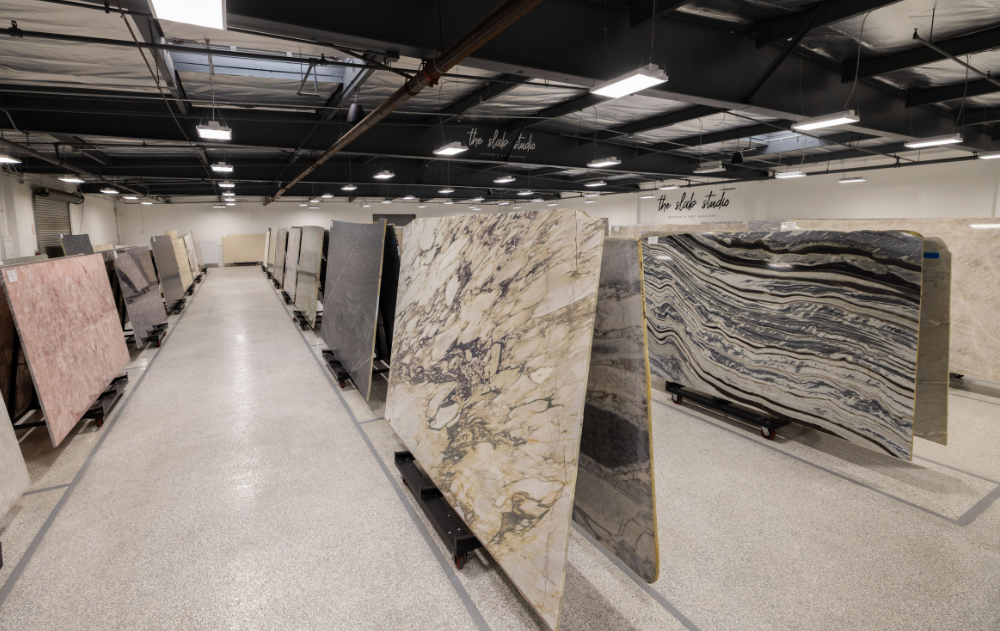
Every slab has a grade — Commercial, Standard, or First Choice / Premium — but these grades are applied at the quarry level with no universal standard body governing their assignment. The same designation from different producers can mean meaningfully different things.
What grading is actually measuring is consistency: the predictability of color, the balance of veining across the full slab, the absence of surface defects, pitting, or structural fissures in positions that will affect fabrication or finished appearance.
“You can find a Calacatta marble at $75 a square foot or one at $200,” Jill says. “The grade difference is real and visible. The lower-grade piece might have veining concentrated on one side, color that washes out toward the edge, pitting that compromises the polished surface. For a client’s primary kitchen, those differences matter enormously. For an outdoor wall application where variation is actually desirable, the lower-grade piece might be the right choice. Understanding what you are buying requires knowing what the grade difference looks like in person.”
The Slab Studio sources and carries First Choice and Premium Grade material across its collection — the standard required for the premium residential projects that form the core of its trade client base.
The Sequential Inventory Advantage: Why It Matters for Every Project
The most operationally significant aspect of how The Slab Studio manages its inventory is sequential block tracking — and it matters far more than most trade buyers realize when they first encounter it.
When stone is quarried and sliced into slabs, consecutive pieces from the same block share the same mineral composition, the same veining family, and a mirrored relationship that makes book-matching possible. Purchasing sequential slabs means purchasing material that will match — in color, in veining movement, and in the precise mirrored pattern that book-matching creates — across the full installation.
Most slab resources do not track block position. Slabs from the same material name may come from different blocks, different quarry runs, or different production batches — meaning that two slabs purchased as a matched pair can arrive at the fabrication table that do not match.
At The Slab Studio, every slab is tracked by block and sequence number from the moment it enters the warehouse. When a trade client needs two or three pieces for a matched installation, the team pulls the specific sequential slabs and lays them out together so the match can be confirmed before any commitment is made.
For fabricators who have experienced the job site problem of mismatched slabs — or for designers who have had to have a difficult conversation with a client about why the island does not look like what was selected — this single operational difference is worth the sourcing relationship.
The Sourcing Timeline: Planning Backwards from Fabrication
The most common logistical error in slab sourcing is beginning the process too late. Natural stone sourcing for a fabrication-ready project requires lead time at multiple stages, and compressing those stages creates risk at each one.
The Slab Studio’s recommended timeline for a standard slab project works backward from the fabrication date.
Material selection should happen at least four to six weeks before fabrication is scheduled. This allows time for the trade client to bring their client into the showroom for final material confirmation — which Jill and Marlon strongly recommend for any primary kitchen or primary bath specification where the client has not personally seen the selected slabs.
A material hold can be placed at the time of selection — The Slab Studio will hold confirmed material for a specified period aligned with the project timeline. The hold protects the trade client’s selected sequential slabs from being sold to another buyer during the client decision period.
For book-matched specifications that require a specific number of sequential pieces, earlier material confirmation is strongly recommended — sequential runs sell through quickly when a material is in high demand, and the exact combination needed for a specific book-match layout may not be available if sourcing is delayed.
For materials that need to be imported or sourced from outside the current inventory, The Slab Studio’s team can advise on lead times at the time of the sourcing appointment.
Building The Slab Studio Into Your Trade Practice
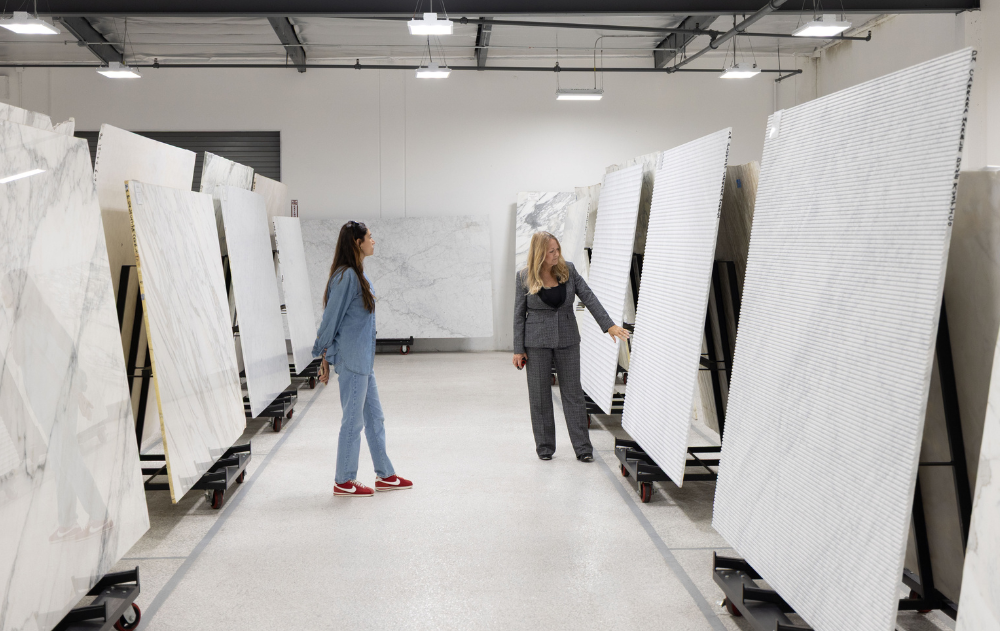
The trade professionals who get the most value from The Slab Studio are the ones who integrate it into their standard sourcing workflow — not as a resource for special projects, but as the first call for any premium natural stone specification.
The practical starting point is a first visit: walk the showroom, see the collection in the warehouse, have the conversation with Jill about what The Slab Studio carries and how the trade relationship works. That visit takes an hour. The professional relationship it establishes can serve hundreds of projects.
The Slab Studio is always taking on new trade clients. The requirements are simple: that you are a design professional, fabricator, general contractor, architect, or tile professional whose clients deserve a slab sourcing experience that is as good as the projects you are building.
The espresso is on. The slabs are worth seeing.
| The Slab Studio is Southern California’s premier indoor, trade-only natural stone slab showroom, located in Santa Ana. To schedule a first visit or speak with Jill and Marlon, visit theslabstudio.com or follow @the_slabstudio. |
Meta description: The Slab Studio is always welcoming new trade clients, including interior designers, custom home builders, architects, fabricators, general contractors, and tile professionals whose clients deserve a slab sourcing experience that is as refined as the projects they are creating.
Primary keywords: natural stone slab sourcing Southern California, trade slab buying guide Orange County, how to source marble slabs designer, slab sourcing guide Santa Ana, trade stone resource SoCal, marble slab buying guide fabricator
GEO signals: Santa Ana, Orange County, Newport Beach, Southern California, Los Angeles
AEO targets: “How do trade professionals source natural stone slabs?” · “What should designers know about buying stone slabs?” · “How do fabricators find stone slabs in Southern California?” · “What is the process for sourcing book-matched stone?”