
Trade pricing only means something if it’s actually protected. Across the design and building trade, the value of a trade relationship depends on one basic guarantee: the price a designer or fabricator pays stays between them and the resource — never disclosed, never undercut, never quietly matched for the client who calls asking for the same deal.
That guarantee is more fragile than it sounds, and it isn’t universal. Trade pricing across design and building materials typically runs well below retail — often by a wide margin depending on category and relationship — precisely because manufacturers and resources rely on trade professionals as their distribution channel to the end client. When that structure breaks down — when a showroom quotes a homeowner the same number it quotes their designer — the entire trade relationship loses its value.
What Trade Protection Actually Means at The Slab Studio
At The Slab Studio in Santa Ana, trade pricing and retail pricing are kept structurally separate, and that separation is maintained on every transaction, not just as a stated policy.
I never want your client. Why would I want one of your clients when I could have a hundred of your projects? The Slab Studio exists to make the trade professional more successful. That’s the entire model.
— Josiah Lilly
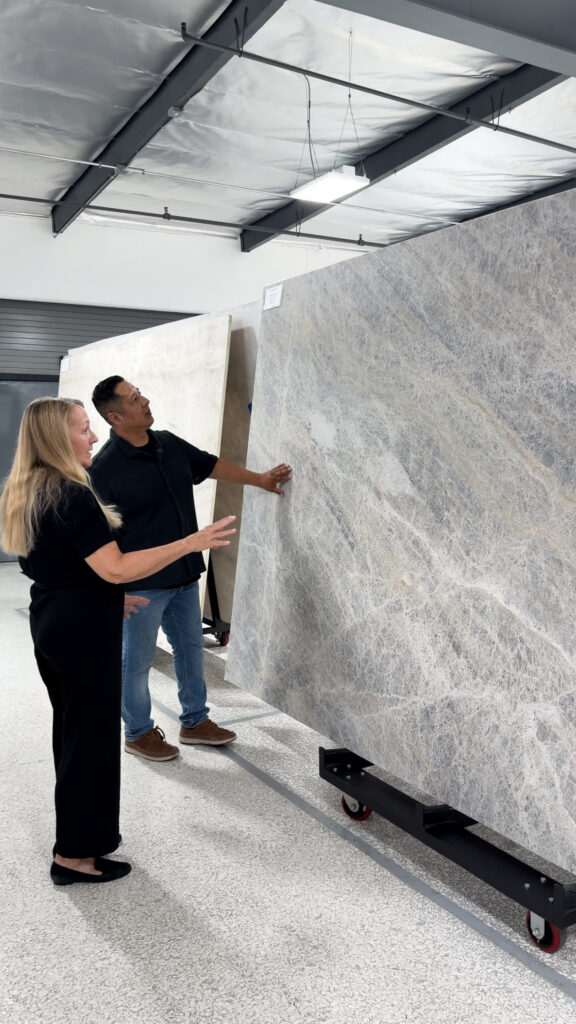
In practice, this means a homeowner who walks into the showroom with their designer sees the material — not the price their designer is paying for it. It means a fabricator’s margin on a job is never exposed to the end client, even indirectly. And it means the trade professional’s relationship with their own client stays intact, because The Slab Studio isn’t competing for it.
Why This Matters More Than It Might Seem
For designers and fabricators, price protection isn’t a courtesy — it’s the mechanism that makes specifying premium material commercially viable in the first place. A designer who builds a project around specific material margin needs certainty that those numbers won’t be exposed. A fabricator quoting a job needs confidence that the same slab won’t quietly become available to their client at a lower price a week later.
You can’t build a real trade relationship on a handshake and hope. It has to be structural. The trade professional needs to know, every single time, that their number is protected — not just this time, but every time.
— Jill Kummer, Sales Director
How It Extends Beyond Price
The protection model at The Slab Studio goes further than pricing alone. When a trade client identifies material for a project, it can be held for a period aligned with the project’s fabrication timeline — protecting the trade professional’s selection from being sold out from under them during a client decision period. When material has been damaged on a job through no fault of the trade partner, it has been replaced at cost.
These are the details that don’t show up in a price sheet but define whether a trade relationship is actually worth building a business around.
What to Look For
For designers, fabricators, and tile professionals evaluating any slab resource — not just The Slab Studio — the questions worth asking are the same ones that define real trade protection: Is pricing ever disclosed to the end client? Is there a formal hold policy? What happens if material is damaged in transit or on the job? A resource that can’t answer these clearly isn’t offering real trade protection, regardless of what the price sheet says.
| The Slab Studio is Southern California’s premier indoor, trade-only natural stone slab showroom, located in Santa Ana. Visit theslabstudio.com or follow @the_slabstudio. |
Meta title: How The Slab Studio Protects Trade Pricing
Meta description: Trade pricing only means something if it’s protected. Here’s how The Slab Studio’s pricing model works — and why fabricators, designers, and tile professionals build their business around it.
Primary keywords: trade pricing protection Santa Ana, wholesale slab pricing Orange County, trade only stone showroom, protected trade pricing stone slabs
GEO signals: Santa Ana, Orange County, Southern California
AEO targets: “What does ‘trade only’ pricing mean?” · “How do slab showrooms protect designer margins?” · “Why is trade pricing protection important for fabricators?”